
September Net
His Excellency President Dr. Rashad al-Alimi, Chairman of the Presidential Leadership Council (PLC) restated his call to the international community to reconsider its approach to the Yemeni crisis, which in previous stages focused only on containing escalation without addressing its causes.
He remarked that experience has shown that truce unless linked to attainable commitments and that doesn’t prevent rearming and resuming attacks, often turn into an opportunity to prepare for a new round of war.
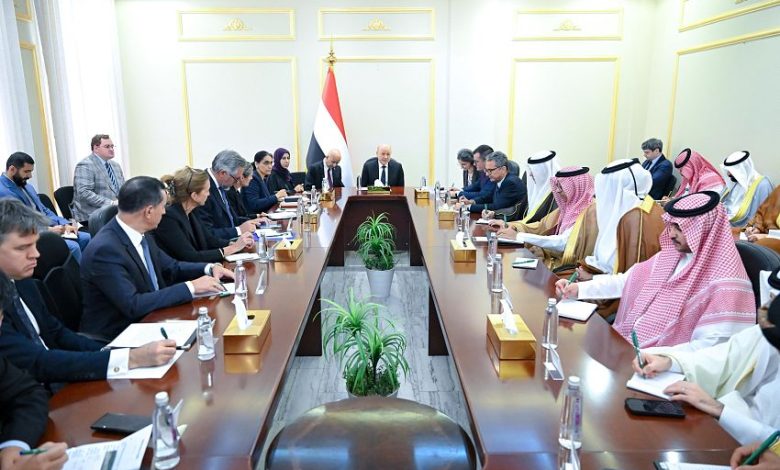
During his meeting today, Wednesday, with the Ambassadors of the countries sponsoring the political process in Yemen, the President emphasized that escalation is a recurring behavior of the rogue militias when they perceive peace as a sign of weakness.
He emphatically stressed that calls for armistice should not come to equate the aggressor with those defending their citizens, nor should the state be asked to refrain from doing its duty while the militias continue using force to impose fait accompli.
The President recalled the government’s repeated warnings that continuing to be tolerant with the militias violations would lead to a new round of war, displacement, and humanitarian disasters, that is exactly what’s happening now.
He made it clear that the government did not start this round of fighting and was not seeking it. The fact is that the Houthi militias are the ones who opted to escalation and they must bear the responsibility for its consequences and its humanitarian and security repercussions.
He said: “So we expect the international community to clearly say who started the escalation, to hold the militias accountable for the consequences, and to support the country’s right to protect its citizens and its sovereignty according to international law”.
He went on saying: “We are not asking the international community to fight instead of the Yemenis, but rather we want the international community to enforce its resolutions, support the Yemeni state’s efforts to restore its institutions, keep weapons and decisions of war and peace in its hands and put an end to the threat that Yemenis, the region and international navigation have faced.”
The Chairman of the PLC considered that implementing the relevant UN Security Council resolutions, primarily resolutions 2140, 2216, and 2722, is not a separate Yemeni demand from international will, but rather an existing commitment that should find its way to effective implementation.
His Excellency briefed the Ambassadors on the overall developments on the national stage, particularly the surge of Houthi militias attacks, which were not limited to Yemen itself but extended to targeting the lands of the Kingdom of Saudi Arabia, in a continuation of their blatant blackmailing approach.
He pointed out that this round of escalation clearly demonstrated that the militias are governed by the Iranian agenda, which began with attempts to operate unauthorized flights to Sana’a, as part of an escalation ladder whose ultimate goal is to reach Bab al-Mandeb and hold state navigation hostage to improve the negotiating conditions for its supporters.
The President noted that this round of Houthi escalation has forced thousands of civilians back into displacement after years of relative calm, through horrific attacks launched by Houthi militias on residential neighborhoods and IDP camps in Marib, as well as on populated areas and civilian and service facilities in Taiz, Hodeidah and other governorates.
He avowed that protecting civilians will remain at the core of the state’s duties, and that the armed forces and government military formations are committed to international humanitarian law, rules of engagement, protecting civilian property, treating detainees properly, and facilitating aid access.
He also stressed that the fight is not against the people in the militias-controlled areas, nor against any social or sectarian group, but against an armed scheme that undermines the state and deprives Yemenis of peace, freedom and a normal life.
His Excellency said that the state has repeatedly called on citizens in militias-controlled areas and those misled not to involve their children in this war and to prioritize the national interest.
The President confirmed that the continued Iranian military and technical support to terrorist militias, along with the flow of weapons, expertise and technology to them, contributes to expanding the Houthi threat and undermines the chances of restoring state institutions through the option of peace.
He went on to say that supporting the Yemeni state in protecting its coasts, ports and territorial waters, and preventing arms smuggling, is not just a Yemeni matter, but part of a shared responsibility for the security of the region and its maritime routes.
President al-Alimi reiterated that the security of Yemen, the security of the Kingdom and the security of neighboring countries are interconnected, and that the continued use of Yemeni territory to threaten regional and international interests will not serve any serious opportunity for peace.
The Ambassadors of the countries sponsoring the political process expressed their strong condemnation of the Houthi escalation and the attacks targeting Yemen and Saudi Arabia, including energy sources and civilian facilities, as well as the threats to navigation and international trade.
They emphasized that these attacks pose a serious threat to Yemen’s security, the region and its stability, and increase the risks of the conflict spreading, disruptions to energy supplies and global trade chains.
They also stressed the need to stop the escalation and hold the Houthi militias responsible for its humanitarian consequences, including civilian casualties, displacement, and added suffering for the population.
The Ambassadors also reaffirmed their countries’ support for the PLC and the government, as well as Yemen’s unity, sovereignty, and territorial integrity.
They confirmed the legitimate right of the Yemeni state to protect its land and citizens in accordance with international law and international humanitarian law.
Minister of Foreign Affairs and Expatriates Afrah al-Zouba was in attendance.