
September Net
His Excellency President Dr. Rashad al-Alimi, Chairman of the Presidential Leadership Council, affirmed today that the Yemeni state and its armed forces are capable of regaining the initiative on the western coast and continuing efforts to liberate the country’s entire territory.
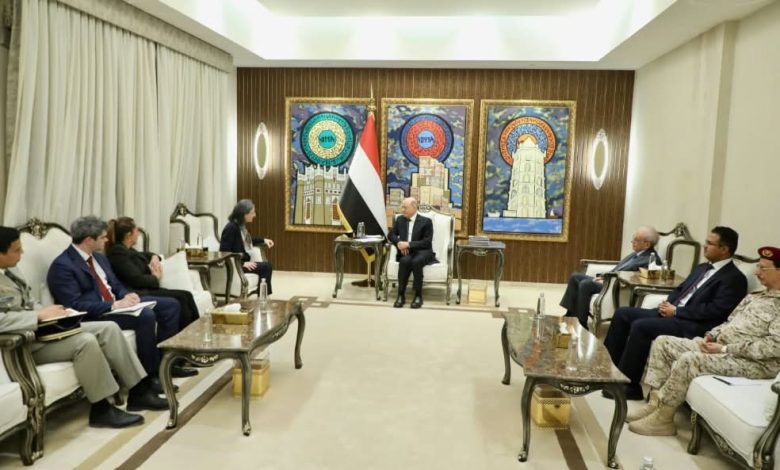
President al-Alimi made the remarks during a meeting with French Ambassador to Yemen Catherine Corm-Kammoun, who paid a farewell visit on the occasion of the conclusion of her tenure.
The Chairman of the Presidential Leadership Council praised Ambassador Corm-Kammoun’s diplomatic efforts to strengthen bilateral relations between Yemen and France, wishing her success in her future duties.
He also expressed appreciation for France’s steadfast support for the Yemeni people and their aspirations to end their suffering and restore state institutions. He highlighted France’s firm position against the Houthi militia’s escalation and its calls for an end to the militia’s supply of arms and funding, as well as its insistence that freedom of navigation in the Red Sea and international straits is non-negotiable.
President al-Alimi stressed that any temporary change on the battlefield would not alter the Yemeni people’s determination to restore national institutions, end their suffering and address the Houthi militia’s threats to international peace and security.
He said the armed forces are continuing operations on multiple fronts, inflicting heavy losses on the Houthi militia in Taiz, Marib, Lahj, Al Jawf, Hajjah, Al Bayda, Dhale’a and other areas. At the same time, forces are being redeployed and their capabilities strengthened to regain the initiative and prevent any temporary battlefield gains from becoming a fait accompli or being used as a platform to threaten vital waterways.
The President said Yemen’s developments have repeatedly demonstrated the state’s ability to turn crises into opportunities. He noted that the Houthi militia had previously believed its seizure of Sana’a and most of the country’s cities was irreversible, before state forces regained the temporary capital, Aden, and more than 70 percent of Yemeni territory.
He added that the current developments mark a new phase in the state’s ongoing efforts to restore its institutions, secure its territory, coastline and territorial waters, and protect maritime routes from armed threats and cross-border smuggling networks.
President al-Alimi emphasized that a strong Yemeni state is no longer merely a national interest but an essential requirement for regional and international security. He called for relations between the Yemeni government and its international partners to move beyond crisis management toward a strategic security and deterrence partnership focused on strengthening state institutions and capabilities, protecting ports and territorial waters, combating terrorism and smuggling, and disrupting the financing and arms networks of rogue groups.