
September Net
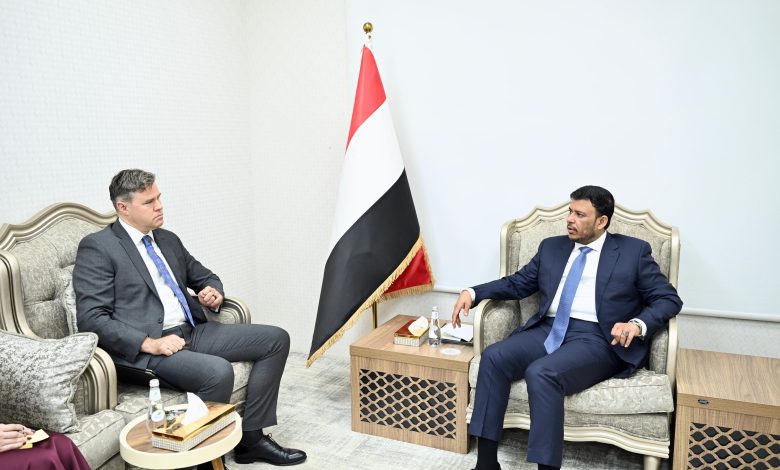
Presidential Leadership Council (PLC) Member Dr. Abdullah al-Alimi Bawazir received Monday the Chargé d’Affaires of the United States Embassy to Yemen Neil Hop.
The two sides discussed bilateral relations between the two friendly countries and prospects for strengthening cooperation across various fields.
Al-Alimi welcomed the US Chargé d’Affaires, reaffirming the PLC and the Yemeni government’s commitment to providing the necessary facilities to ensure the success of his diplomatic mission and to further strengthen the bonds of friendship and partnership between Yemen and the United States.
The meeting reviewed the latest developments on the national scene, as well as ongoing bilateral cooperation and US support for the Yemeni government in combating terrorism, safeguarding security and protecting freedom of international navigation.
He expressed his appreciation for the United States’ supportive role toward the Yemeni government, stressing his aspiration for a more advanced phase of partnership between the two countries that would contribute to strengthening state institutions and enhancing their ability to address security, economic, and humanitarian challenges.
The PLC member briefed the US diplomat on rapidly unfolding developments on the ground, particularly the terrorist attacks carried out by the Houthi militias using missiles and drones against the cities of Mokha and Marib, as well as attacks targeting vital ports, armed forces positions, displacement camps, and civilian facilities, further exacerbating the humanitarian and economic suffering of the Yemeni people.
He said the Houthi militia’s continued attacks on ports and civilian infrastructure and their threats to maritime navigation once again expose their nature as an instrument of the Iranian project in the region.
He stressed that turning a blind eye to these threats encourages the militia to continue undermining security and stability.
He added that the Houthi militia, which claim that areas under their control are under siege, are themselves targeting ports, airports, and economic facilities while threatening commercial vessels and food and fuel supplies, in an attempt to strangle the Yemeni people and deepen their humanitarian suffering.
The PLC member stressed that this escalation places the international community, foremost among them the United States, before a clear responsibility to protect Yemenis’ right to safe access to their ports, airports, and vital facilities.
He called for moving beyond containing the Houthi threat toward addressing its sources and means, while supporting Yemeni state institutions and their capacity to protect the country’s territory, waters, and citizens’ interests.
Al-Alimi affirmed that protecting international maritime navigation cannot be separated from addressing the root causes of the crisis in Yemen, noting that threats to maritime routes are a direct consequence of the continued Houthi coup and the group’s transformation into a permanent source of regional and international instability.
He stressed that securing maritime routes begins with eliminating the threat on land.
He also called for a firmer US and international stance toward parties that continue to support and arm the Houthi militias, as well as pressure to halt external interference that has prolonged the war.
He stressed that terrorist militias should not be allowed to extract concessions through coercion that they have failed to achieve by force.
He noted that any understandings reached in the region should lead to sovereign national states in which legitimate instruments of force are held exclusively by constitutional institutions representing all citizens.
He emphasized that restoring Yemen’s state institutions serves Yemeni, Arab, and international interests and constitutes a genuine guarantee for the security and stability of this strategically vital region of the world.
For his part, the US Chargé d’Affaires reaffirmed his country’s continued support for the Presidential Leadership Council and the Yemeni government, as well as its commitment to strengthening the partnership between the two regional security, and ensure freedom of international navigation.