
September Net
Chairman of the Presidential Leadership Council Dr. Rashad al-Alimi has affirmed that Fajr Al-Yemen or Dawn of Yemen Operation will continue until its ultimate objective is achieved: Ending Houthi militia’s coup, restoring state institutions and ensuring that decisions on war and peace and control of weapons remain exclusively in the hands of the state and its constitutional institutions.
He stressed that this decision is final and irreversible, regardless of the sacrifices involved.
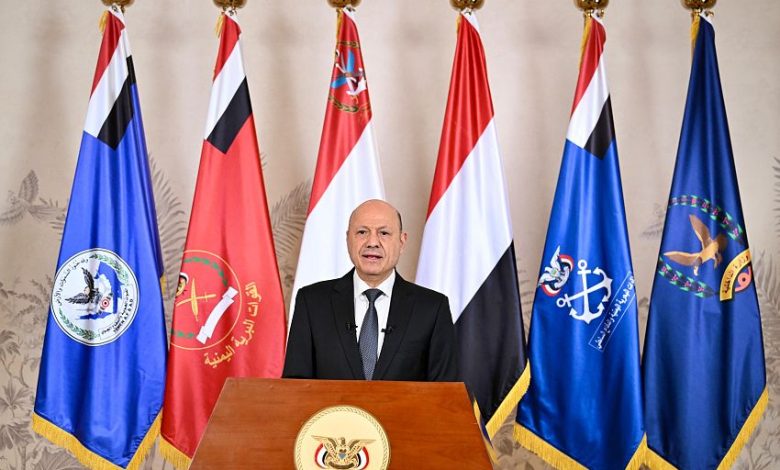
In a speech marking the 63rd Anniversary of October 14 Revolution, President al-Alimi commended the performance of the armed forces since the operation’s launch, emphasizing that temporary developments on the ground would not deter the state from fulfilling its responsibility to end the Houthi threat, with support from regional and international partners.
The president reaffirmed the Presidential Leadership Council’s commitment to the Southern cause and its support for the outcomes of South-South dialogue, under Saudi Arabia’s auspices, aimed at reaching a just and comprehensive settlement that addresses past grievances, respects the will of the people and safeguards rights, political partnership, and a secure future for all.
He praised the sacrifices made by the people of the southern governorates in defending the state and the republican system, as well as their role in pushing back Houthi forces.
He also commended the ongoing efforts of al-Amaliqa or the Giants Brigades, Derea Alwatan or the Nation’s Shield Forces, other military and security units and popular resistance forces, particularly in supporting the besieged governorate of Taiz.
Al-Alimi stressed that the Houthi threat extends beyond any single governorate or region, posing a danger to the security, freedom, and future of Yemenis across both the north and south. He emphasized that developments in Taiz and Marib are inseparable from the security of Aden, Hadhramawt and other governorates, adding that protecting the south’s stability and safeguarding the rights and aspirations of its people are integral to the national responsibility.
The president explained that Fajr Al-Yemen Operation was launched after all opportunities for de-escalation had been exhausted and the Houthi militias continued their war and expanded attacks on cities, villages, neighboring countries, and international waterways.
He said the operation’s core objectives are to restore state institutions, protect civilians, end the coup and return control of weapons and decisions on war and peace exclusively to the state and its constitutional institutions, thereby upholding the rule of law and preventing any armed group from overriding the will of the people or threatening neighboring countries and international shipping lanes.
Addressing the deteriorating situation in Taiz, al-Alimi pledged to deploy all available state resources to protect the governorate, reopen roads, and alleviate suffering of its residents.
He expressed confidence in the resilience of the people of Taiz and the determination of the armed forces, security personnel, and popular resistance.
He announced that the government, local authorities, and relevant agencies had been instructed to mobilize available resources to meet Taiz’s urgent humanitarian needs, provide food and medicine, assist displaced people and affected families, secure the delivery of essential supplies and reopen vital roads.
In a message to civilians living in areas under Houthi control, the president emphasized that they are not targets of Fajr Al-Yemen Operation stressing that protecting their security, rights, and dignity is among the operation’s principal objectives.
He urged families to shield their children from recruitment campaigns, refrain from involving them in the militias’ wars, stay away from military positions and combat zones and take advantage of the announced safe-return and amnesty arrangements in accordance with applicable legal provisions.
Al-Alimi condemned Houthi attacks on Saudi Arabia, particularly the reported attack targeting King Khalid International Airport, which resulted in civilian deaths and injuries, including those among performing Umrah pilgrims from various nationalities.
He also denounced attacks on civilian and vital infrastructure that threatened the security of the holy sites.
The President underscored the close link between Saudi Arabia’s security and stability and Yemen’s own security and national interests, noting that attacks on the Kingdom and its civilian infrastructure undermine the vital interests of the Yemeni people and threaten regional stability.
He expressed profound gratitude to Saudi Arabia, under the leadership of the Custodian of the Two Holy Mosques, King Salman bin Abdulaziz Al Saud, and Crown Prince and Prime Minister Mohammed bin Salman bin Abdulaziz, for their steadfast support for the Yemeni people, national institutions, and armed and security forces.
He praised Saudi assistance to state institutions, the national economy, and the public budget, as well as its contributions to maintaining essential services and salary payments, providing humanitarian relief, clearing landmines, rehabilitating infrastructure, and implementing development and reconstruction projects.
Al-Alimi also welcomed the royal directives aimed at regularizing the status of Yemenis residing in Saudi Arabia without proper legal status, describing the initiative as a humanitarian measure affecting the lives of millions of Yemenis and reflecting the deep fraternal ties and shared interests between the two countries and their peoples.
Reflecting on the significance of October 14 Revolution, the president said it was not merely a milestone in ending colonial rule, but also the beginning of a project to establish a modern civil state, build institutions, expand education, and strengthen women’s participation in national and social life.
He noted that the September 26 and October 14 revolutions embodied the Yemeni people’s determination to achieve freedom and dignity and establish a state whose legitimacy derives from the people and where rights are protected by the rule of law.